
Five Questions with United Machinists
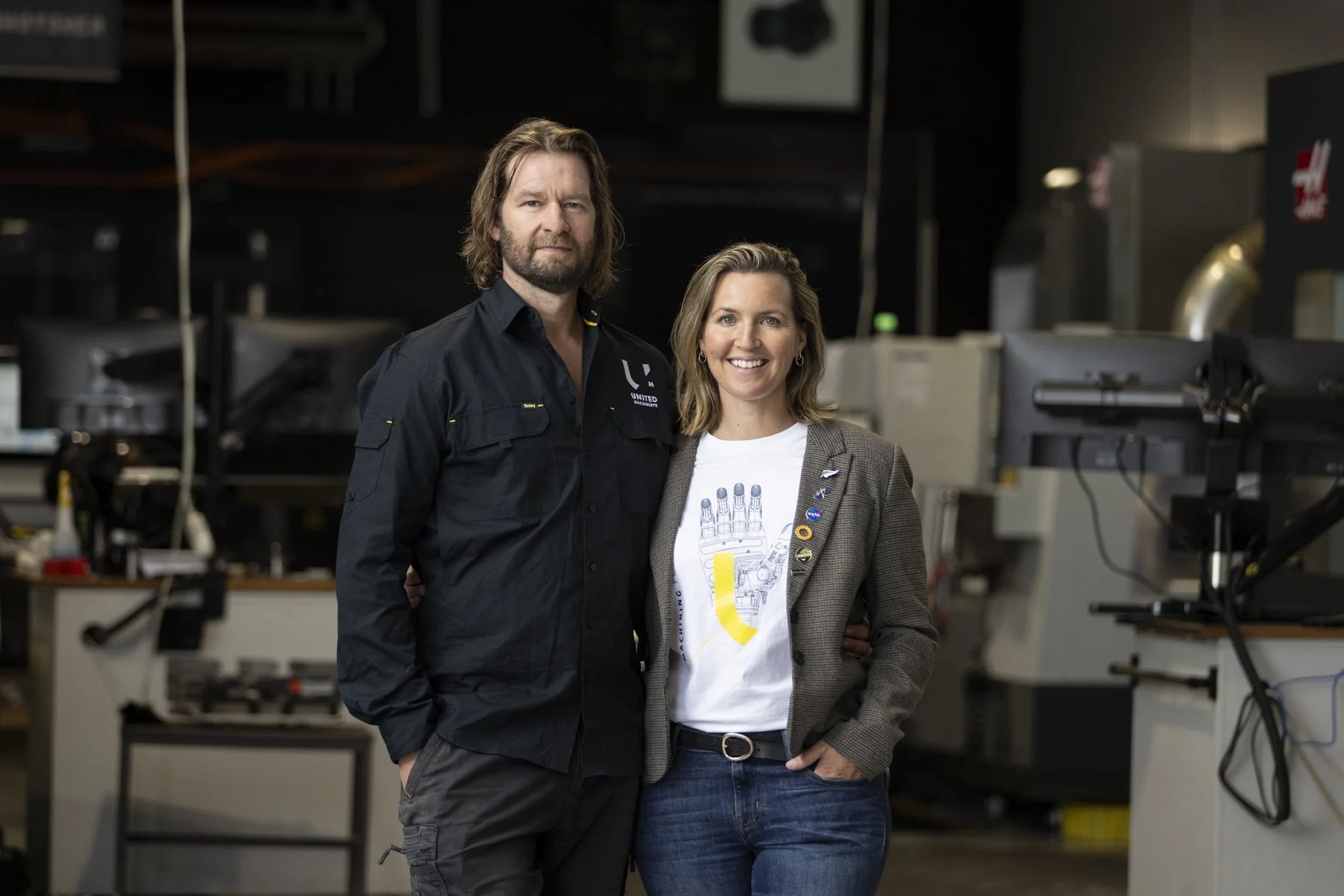
Sarah Ramsay - Chief Executive Officer
Alex Ramsay - Chief Technical Officer
We composed a short interview with Sarah Ramsay from United Machinists to gain a snapshot view into how the company works, and her thoughts on the aerospace industry.
What does your organisation do — and why does it matter for NZ's aerospace future?
Put simply, we manufacture mission critical components. We take complex engineering designs from our customers and develop the process to manufacture them - often times down to less than 10 micron tolerances.
Each year we manufacture over 14,000 parts that go to space. They’re typically low volume, highly complex and high value - an area underserved globally, with most industrial manufacturing nations preferring to focus on higher repeat production industries. Which leaves a real capability and capacity gap globally for high risk low volume industries such as aerospace.
It’s not just about having the advanced capability to make these companies - but also the sophisticated systems required to provide full traceability across materials, processes and serial batch production.
2. What's the big focus for you and your team this year?
We’re having another big push at growth! We will increase our overall production capacity by 40% through the development of a new machine shop and machinery.
But the biggest focus is actually on organisational capability, with an emphasis on bringing in new management capability, internal promotions and upskilling, digital and production automation. Once that’s all in place, we have set ourselves the ambitious target of achieving our AS9100 accreditation by the end of FY26.
3. Is there a technology or capability that's moved faster than you expected in the last 12 months?
AI has and hasn’t moved as fast as I thought. It’s absolutely making some things much more efficient and accessible, particularly around administrative and corporate functions. However we haven’t seen the progress I would have expected in its translation to physical processes yet. I suspect it's coming, and we have some of our own ideas! But I don’t think we’re going to see humanoid AI robots as commonplace on the factory floors in my lifetime - and quite honestly I hope we don’t.
4. Where are you actively looking for connections right now: partners, customers, suppliers, talent?
All of the above! We’re always looking for great talent. However with our new facility scheduled for completion in September, I’ll be actively shaking cages for new business - particularly export opportunities into the aerospace and advanced aviation sectors. I think United Machinists and New Zealand more broadly, have a lot of value to add to global supply chains in tricky, low volume, mission critical manufacturing.
5. What would make NZ a more compelling place to grow an aerospace business in 2026?
As above, New Zealand bats well above our weight from a capability and space heritage perspective globally. We need to be promoting not just our emerging OEMs, but the whole integrated industrial supply chain across the aerospace and advanced aviation sectors - ensuring that as an industry we have a clear strategy, positioning and we collectively go for it. NZ is a tiny part of global GDP, but we can and should have an influence outside our scale in the space race! It needs to be a national strategy though and needs proper funding to compete with other countries trying to catch up. We really do have a first to market opportunity to leverage Rocket Lab’s putting NZ on the map, and I feel like that’s slipping past us.
We thank Sarah for her insightful responses and perspectives, and can’t wait to see the part United Machinists plays in the future of Aotearoa’s aerospace industry.
