
Aerospace New Zealand recently asked Sarah Pratt from Asteria Engineering six questions to find out what makes the company tick.
Asteria Engineering is New Zealand's specialist aerospace engineering consultancy, bridging the gap between ideas and mission-ready reality. Specialising in bespoke electronic and mechanical design where failure isn’t an option, Asteria often acts as an external R&D wing, creating flight-ready hardware and mission-critical systems. Their core capabilities span nanosatellite development, payload integration, advanced power electronics, embedded systems, and more. With over 50 subsystems in orbit, Asteria empowers innovators to achieve mission success and reach the stars.
Keep reading to see the enlightening responses Asteria had to our questions.
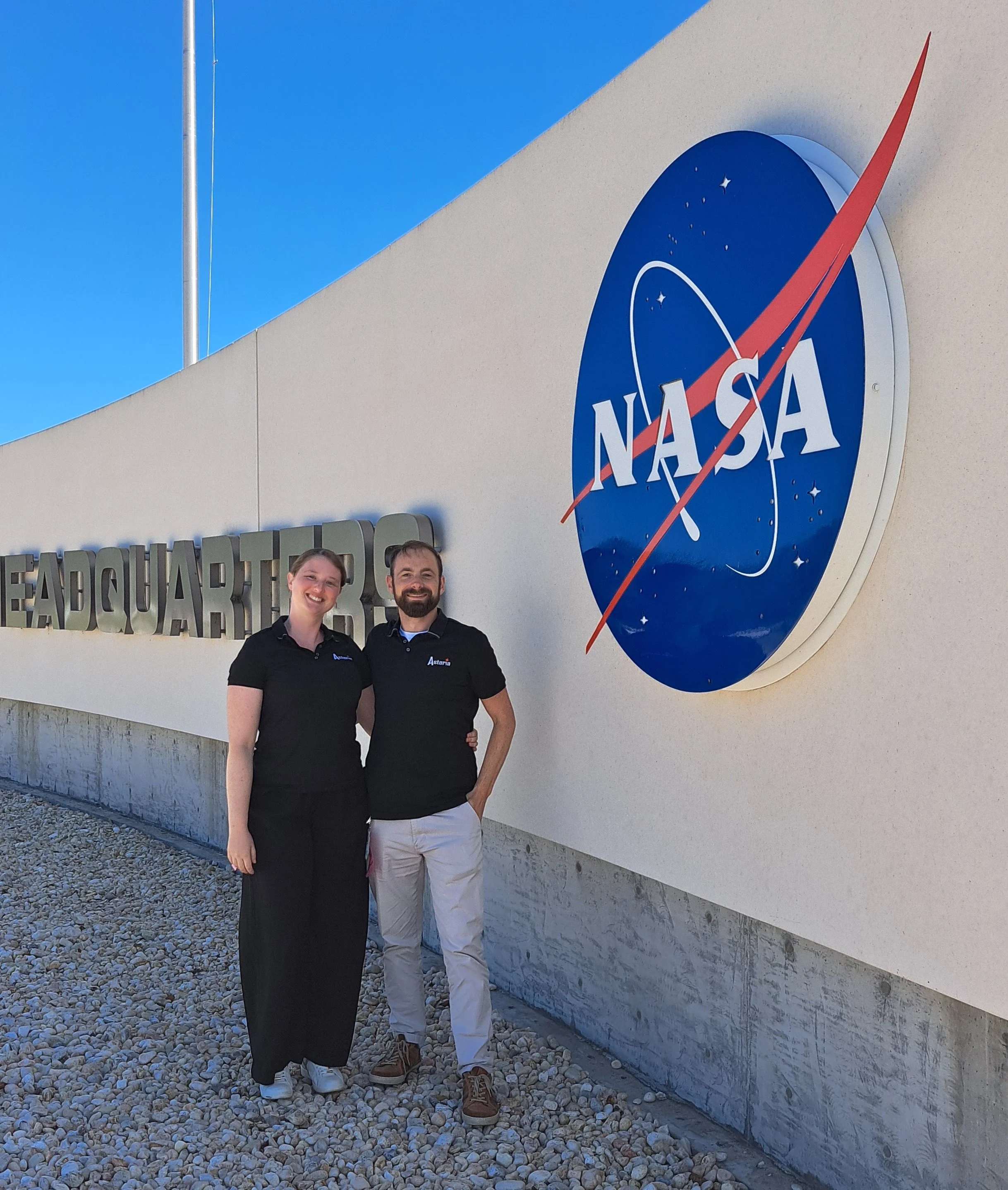
Sarah Pratt, Buisiness Manager and Founder
David Wright, Principal Engineer & Founder
What were the key steps involved in building Asteria into what it is today?
Great question! It was 2017 when Sarah Pratt (Business Manager) and David Wright (Principal Engineer) faced a choice: each get a job and contribute to just one company’s goals and dreams, or start our own specialist electronic product design firm and help numerous New Zealand companies and innovators reach the stars. When the aerospace sector was in its infancy, we chose to operate as an industry enabler rather than a competitor.
One of our founding goals was to play a key part in growing New Zealand into an aerospace powerhouse, and offering our expertise – helping everyone from fellow engineers to scientists to founders create high reliability, lightweight products that do what they need to first time – has helped the NZ aerospace ecosystem grow steadily in the eight years we’ve been in business.
As for the key steps to growing Asteria:
David and Sarah starting the company in their spare room in 2017 (we even had to share a desk!), serving North American clients within our existing aerospace network.
Growing our customer, supplier, and collaborator network in New Zealand, engaging with start-ups like Dawn Aerospace and Kea Aerospace and with local government bodies.
Moving into supporting the research space, including helping write successful Endeavor applications which resulted in two five-year projects to send payloads to the ISS.
Growing our workforce, bringing in more specialist engineers to expand the breadth of aerospace skills and knowledge we can offer clients, and enable us to serve more clients at one time. Between suppliers, contractors and our own employees, we have really great expertise in our wider network that we can draw on.
Moving into larger offices enabled us to expand and build upon our testing facilities.
Investing in developing GaNDev: a power system prototyping platform that enables our clients to harness the power of Gallium Nitride semiconductors, an emerging transistor technology that offers great rewards but is difficult to use effectively without experience. We’ve since used this to develop power systems for several clients.
What are some of the challenges your company has faced and how have you overcome them?
Timeframes can be challenging! Our clients often come to us when they rather suddenly need something done and they don’t have a lot of time to do it. Working at Asteria means juggling many projects and ever-changing timeframes, which we actually enjoy. Our team always puts in the work to achieve the client’s goals as soon as we can.
New Zealand’s manufacturing sector is world-class but the space industry has unique, rigorous demands, and the manufacturers here are sometimes unaware of the standards required. We have spent years working on this, partnering with manufacturing leaders to bridge the gap between high-end production and aerospace standards. This upskilling keeps innovation onshore, ensuring NZ startups can manufacture locally, and we are proud of the awesome work some of our manufacturers in NZ do and the quality of products we get to send to our clients.
The other key challenge we have is that, in general, New Zealand founders like to hire their own staff over bringing in contractors. The advantages to bringing in contractors like us are clear:
You get access to the knowledge and skills of all our staff, not just one person.
We have quality testing facilities so you don’t need to buy your own equipment unless you want to.
Our work is high quality and comes with the Asteria stamp of approval.
We have a network of suppliers all over the world and know who to go to for what jobs.
We can hit the ground running (no training or HR required) and we are available when, and only when, you need us. Got nothing for us to do for months? Or need us to start in a few weeks? No worries.
Some founders worry about not keeping their learnings in-house, but that’s not an issue with Asteria – in fact, oftentimes we are brought in to teach and guide early-stage engineers, and we have helped some of the big names in aerospace grow their engineers’ capabilities to the point that they no longer need our help (something we’re quite proud of).
We also know when not to reinvent the wheel. If there is something a client can buy to achieve their goals, we will direct them to it.
Lastly, we offer Design Reviews, which are useful even if you have a full internal team, as an Asteria engineer can come in with no prior knowledge or bias of the project, do a deep dive into the design, and provide recommendations based on our years of experience creating aerospace electronics.
How have we overcome this challenge? To be honest, we face it all the time and will continue to – it’s mainly about having down to earth conversations with founders and leaders, being clear with how and when Asteria can help.
What has been your biggest success story so far?
We are incredibly proud of the breadth and success of missions we’ve worked on and the number of innovators and engineers we’ve helped. As of writing this, we have led the electrical hardware development of over 50 subsystems for 25 spacecraft that have launched. For a team of only four people, that’s pretty incredible. We have also provided critical engineering support to nearly every player in the NZ aerospace sector, which has been an honour.
Our impact is most visible in the hardware development for NZ’s first missions to the International Space Station:
1. Paihau-Robinson Research Institute’s Hēki mission, which is an ambitious test of a superconducting magnet and power supply in space.
2. Dr Sarah Kessans’ LUCY biological laboratory, which was built to explore how microgravity in space will benefit protein crystal experiments.
We led the development and integration of the electrical systems for both these payloads, along with the mechanical system for LUCY, and both clients have said that they couldn’t have achieved their goals without our help.
How do you take a client’s project from an idea into a reality?
There’s a good overview of our typical process on our website: asteriaengineering.com/process.
Not all our clients follow this process – some only need Design Reviews or want us to come in part way through development – so we tailor this process to the specific circumstances of each client.
We actively guide and support our clients through each of these stages. We have built quality relationships with suppliers and know which ones can achieve what we need.
Our projects typically range from a month to five years, depending on the scope of the work.
Where do you see Asteria Engineering in ten years and how will it be impacting the
aerospace industry?
Given the NZ aerospace industry grew 53% in the last five years, I imagine our industry will be wonderfully large and thriving in 10 years, and Asteria alongside it! We will continue to serve the industry here at home, helping start-ups grow, helping large organisations create specialty aerospace products (e.g. we often get brought in as power systems specialists) and helping researchers and scientists take their work to space. It’s a very exciting time to be in aerospace in Aotearoa.
Are there any upcoming projects you’re most excited for?
There are so many! One we are very excited for right now is the follow-on project after LUCY, which is a more complex and commercial-ready space lab to investigate how microgravity influences protein crystallography. We are currently building the prototype right here at the Asteria office, and it’s so exciting to see the team’s work come to life in front of us. This payload will launch within the next year, and we will be popping the bubbles when it does!
We thank Asteria for their incredible responses and for giving us the opportunity to peek behind the scenes.